
How Qortal Combats Internet Censorship
December 30th, 2024
Web3
Privacy
Blockchain

The free internet is dying! Yes, it’s true: a free and unfettered access to the internet is becoming a privilege for more and more people every year, as governments, and even corporations, crack down on content that doesn’t align with their particular viewpoints or ideologies. But the arrival of Web3, more specifically, Qortal, presents a new hope for an uncensorable, alternative internet. This will be explored further in this article.
Censorship is very bad news for the current internet in many ways, especially given that the foundations of today’s internet are based on openness, permissionless innovation, security, stability and global interoperability.1

Censorship has become commonplace on the internet2
These values have been compromised in many ways, making it harder to express one’s opinion freely, especially in the domain of politics, religion, and other sensitive topics. For example, China’s Great Firewall was deployed in 1994, with the objective to selectively separate Chinese cyberspace from the outside world and to prevent Chinese citizens from accessing information that the government has deemed detrimental or potentially destabilizing to the country’s interests.3 This is an extreme example, but is not the only country censoring their internets, with Iran, North Korea, Russia, and even Singapore having similar measures in place.
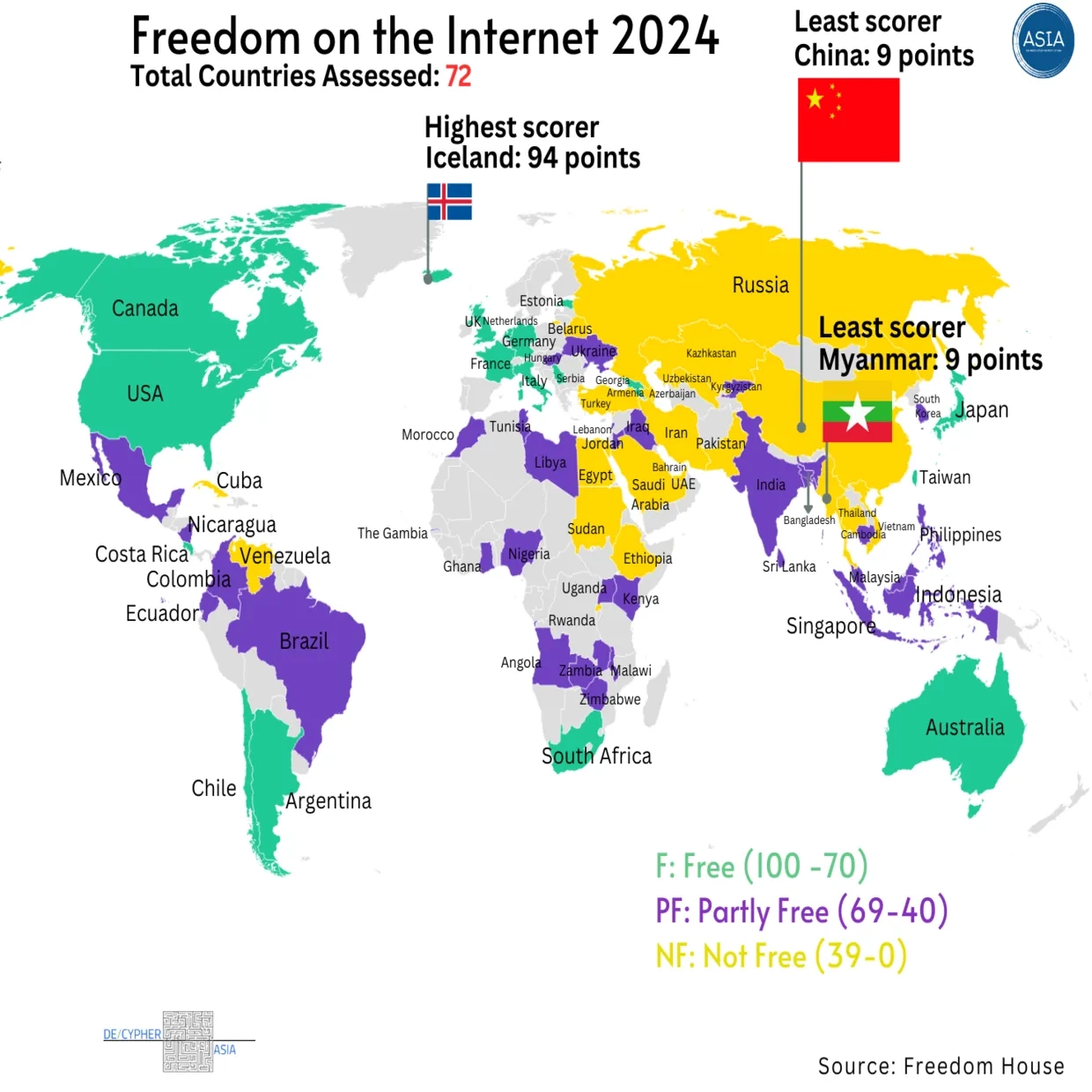
Not every country benefits from the same kind of internet freedom4
An example of censorship more relevant to Western countries is that of Amazon Web Services refusing to host the servers for the internet news company “Parler”, after it deemed it had not done enough to moderate or police content posted there, and was thus in violation of their various terms of service.5 This can be a devastating blow for an internet company, especially if they had much of their services being run by AWS.
Needless to say, censorship has become commonplace on the normal internet, but is this something humanity must simply accept as the new normal going forward? The answer is no, and comes from a brand new way to exchange data on the web: Qortal.
Qortal leverages blockchain technology to permit users to browse a peer-to-peer, decentralized network, where no single entity (or node) controls all of the data, as is the case on the normal internet.
In the Web2 sphere, private companies are wholly in control of user data, being able to use it as they please. This data is often negligently misused, being sold to third-parties, leaked to hackers, or in the case of censorship, deleted entirely! All this without any recourse from the users which are completely at the whims of these companies.
Qortal and Web3’s promise is to return the control of the data to ther users themselves, giving them the power back in how, and to whom, they choose to share their data. In the case of Qortal, all the data is tied to the user's name, and follows them everywhere they go on the blockchain.6
Most importantly, nobody can censor, delete, or prevent a name from doing anything at all on Qortal, since there is no centralized authority at all. The most one can do is “block” a name, which would effectively prevent that person’s node from viewing and propagating data attached to that name.
In essence, Qortal’s entire infrastructure and architecture is censorship-proof, and gives hope to individuals having been silenced on the normal internet. Furthermore, with the future arrival of “Reticulum”, a mesh network on Qortal, users will theoretically no longer even need an Internet Service Provider (IPS) to be able to access Qortal, ensuring that every transaction and communication on the Qortal network will be shielded from external surveillance and interference once implemented.7

One of the cornerstones of Qortal is that it is censorship-proof!8
Therefore, the future of the internet is not so bleak after all, and those having suffered at the hands of centralized authoritarian bodies, can find refuge and comfort knowing alternatives exist, including a very good one in Qortal, which has been around since 2020, and continue to grow in strength and reach every single day! And the best part: it’s available on your favorite device, whether that’s a laptop, phone, or even browser extension. Visit the downloads page to download it today!
1. Tony Blair Institute for Global Change. (n.d.). The open internet on the brink: Origins and evolution. Retrieved December 29, 2024, from https://institute.global/insights/tech-and-digitalisation/open-internet-brink-origins-and-evolution
2. Google Blogger. (n.d.). Internet censorship CISPA: Newest cybersecurity bill [Image]. Retrieved December 29, 2024, from https://blogger.googleusercontent.com/img/b/R29vZ2xl/AVvXsEi-2pvhbLKv0hl4MVbx8BTWYAu8v3xIsCa83VgaXaDdTNa1eCsk-IS7eKApo_LRvij-d9hkxD3y5-oPzAb1nT6XbCvLc13MNfUulKDKHHLWjbI7kz2xoz4Ghm2oHF6QmoDXsuN5A7f_89vJ/s640/Internet+Censorship+CISPA+-+Newest+Cyber+Security+Bill.png
3. Encyclopaedia Britannica. (n.d.). Great Firewall. Retrieved December 29, 2024, from https://www.britannica.com/topic/Great-Firewall
4. Voronoi App. (2024). Freedom on the Internet 2024 [Map]. Retrieved December 29, 2024, from https://www.voronoiapp.com/maps/Freedom-on-the-Internet-2024-2776
5. Harwell, D. (2021, January 11). Amazon, Parler, and the perils of moderating the internet. Time. Retrieved December 29, 2024, from https://time.com/5929888/amazon-parler-aws/
6. Qortal Wiki. (n.d.). Name registration. Retrieved December 29, 2024, from https://wiki.qortal.org/doku.php?id=name_registration
7. Dodgers Design. (n.d.). Qortal Reticulum: Pioneers of untraceable decentralization. Medium. Retrieved December 29, 2024, from https://medium.com/@dodgersdesign/qortal-reticulum-pioneers-of-untraceable-decentralization-3b049c702e5b\
8. Ferrari, Justin. (2024). The 6 Cornerstones of Qortal [Image]. Canva.